← Case studies · AI audit · Hospitality & events · 14 days
A small catering business leaking $85,200 a year and 30 hours a week
waste priced, per year
largest single leak
of busywork, every week
“I was just trying to update the invoice. That's all I was trying to do. And it turned into a 20-minute job.”
A catering company running events and functions. Owner-led and small: the owner, a bookkeeper, an events coordinator, kitchen staff and an offshore VA. Growing steadily, and feeling the admin load that comes with growth. The owner's own summary was that admin labour had become one of the biggest areas of cost in the business, and the day-to-day was proving it. Small jobs kept turning into long ones, and nobody could say exactly where the time was going until the audit sat down and traced it.
Three different platforms bolted together, with a Google Sheet in the middle holding it all. They had already been burnt once: signed up with an overseas catering system, paid the onboarding fee, did all the data entry, then found out it could not take Australian cards. A couple of months' worth of loss, in the owner's words. Every deposit meant a seven-step manual checklist across four separate tools. Run sheets were printed on paper and stuck on the kitchen fridge for the chefs. And after each event, one email went out, and that was the entire follow-up.
Findings & waste analysis
Catering company, events and functions · audited April 2026
- Manual data entry across the disconnected tools$47,450/yr
- Missing automation, including a 7-step manual deposit checklist across four tools, daily$22,750/yr
- Upsell revenue never captured: one post-event email, no follow-up at all$15,000/yr
- Duplicate work, including packing lists that are never fully right and get double-checked by hand$7,800/yr
- Communication gaps, including run sheets printed on paper and stuck on the kitchen fridge$1,300/yr
figures verbatim, in the client’s own rates · names removed
The audit surfaced 77 findings across 11 areas of the business, from lead acquisition through quoting, event fulfilment, rostering and bookkeeping. The quantified slice came to $85,200 a year and 30 hours a week. Manual data entry across the disconnected tools was the biggest line at $47,450 a year. Missing automation, including that daily deposit checklist, added $22,750. And $15,000 a year of upsell revenue was never captured, because the follow-up after an event was one email and nothing more. Even updating a single invoice had turned into a 20-minute job.
Free 45 minutes · one workflow mapped in depth
How it ran before
- Manual data entry across the disconnected tools
- Missing automation, including a 7-step manual deposit checklist across four tools, daily
- Upsell revenue never captured: one post-event email, no follow-up at all
The blueprint we handed over
- connects the tools so data gets entered once, not three times.
- automates the deposit checklist and the invoice sync, so a booking change stops turning into a 20-minute job.
- builds a real post-event follow-up and upsell sequence in place of the single email, so the repeat revenue that was quietly leaking starts getting captured.
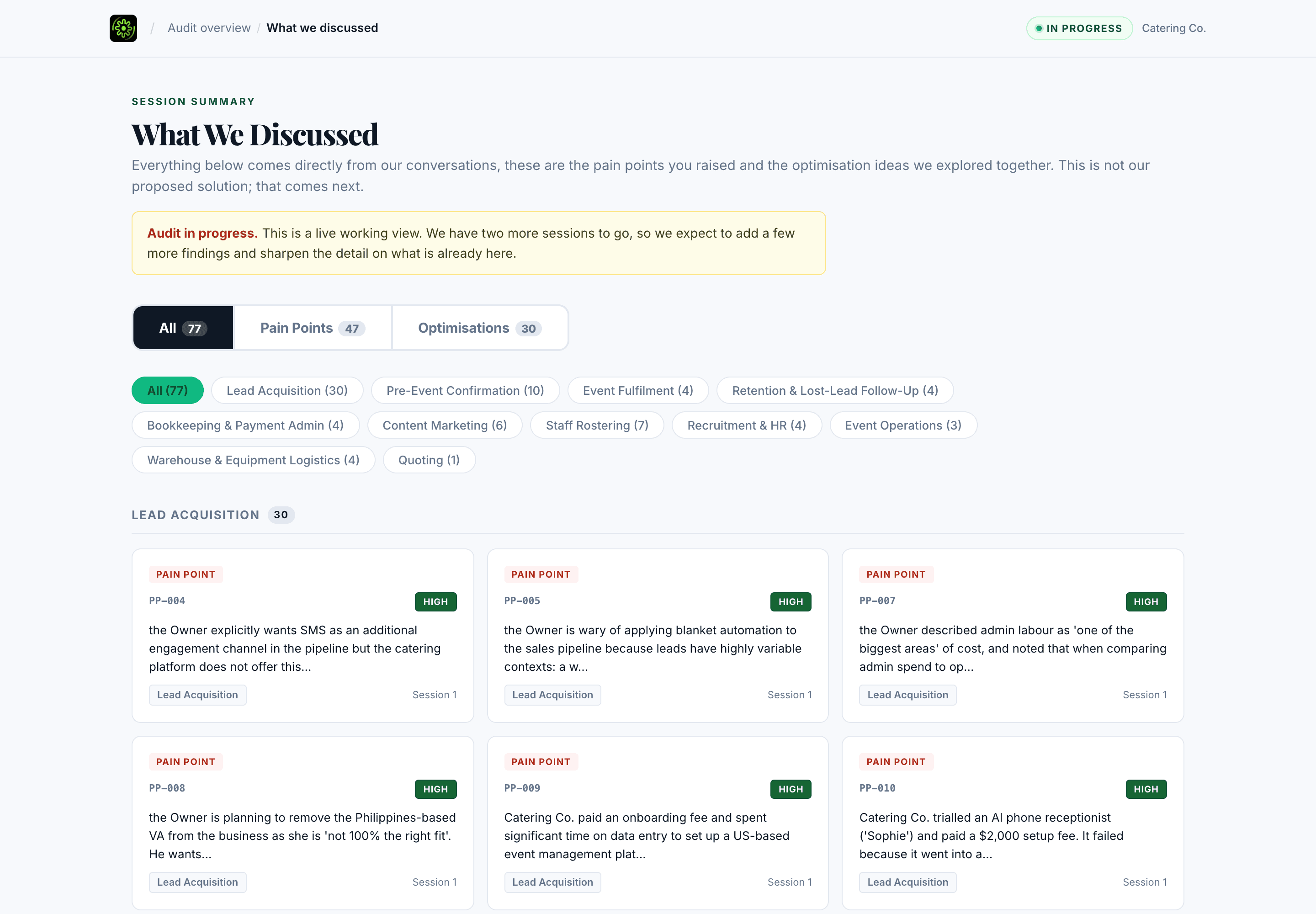
A page from the actual day-14 deliverable, names removed. The full document maps every process, prices every leak, and ends in a build plan in priority order.
Walk through a full sample audit →Kickoff
Team sessions, every handoff mapped
Every leak priced in their rates
Findings + blueprint, live
“The accounting side won't export if there's a payment attached. The catering side won't export if there's a payment attached. And that's just stupid.”
None of this was visible from the owner’s chair.
Found by mapping the operation person by person, and pricing what came up. Same method, your rates: 3× the fee in findings, or the audit is free.